You pull into the driveway in the middle of a downpour, hit the button, and the garage door reverses immediately or refuses to close at all. If this only happens during or after rain, the problem isn’t your opener — it’s your sensors. Understanding how rain affects garage door sensors saves you from unnecessary service calls and helps you fix most issues yourself in under ten minutes. Water, condensation, and shifting ground conditions attack sensors in specific ways. This guide walks through every one of them.
How Garage Door Sensors Work — and Why Rain Disrupts Them
Every residential garage door opener built after 1993 includes a pair of photoelectric safety sensors mounted near the bottom of the door tracks — one on each side. One sensor sends an invisible infrared beam across the opening. The other receives it. When the beam stays connected, the door closes normally. When anything breaks the beam, the door reverses or refuses to move.
Rain disrupts this system in multiple ways. Water droplets scatter the infrared beam. Condensation fogs the sensor lenses. Heavy rain shifts the ground or track hardware enough to knock sensors out of alignment. Each of these produces the same result — a door that won’t close — but each one has a different fix.
How Rain Affects Garage Door Sensors Through Lens Contamination
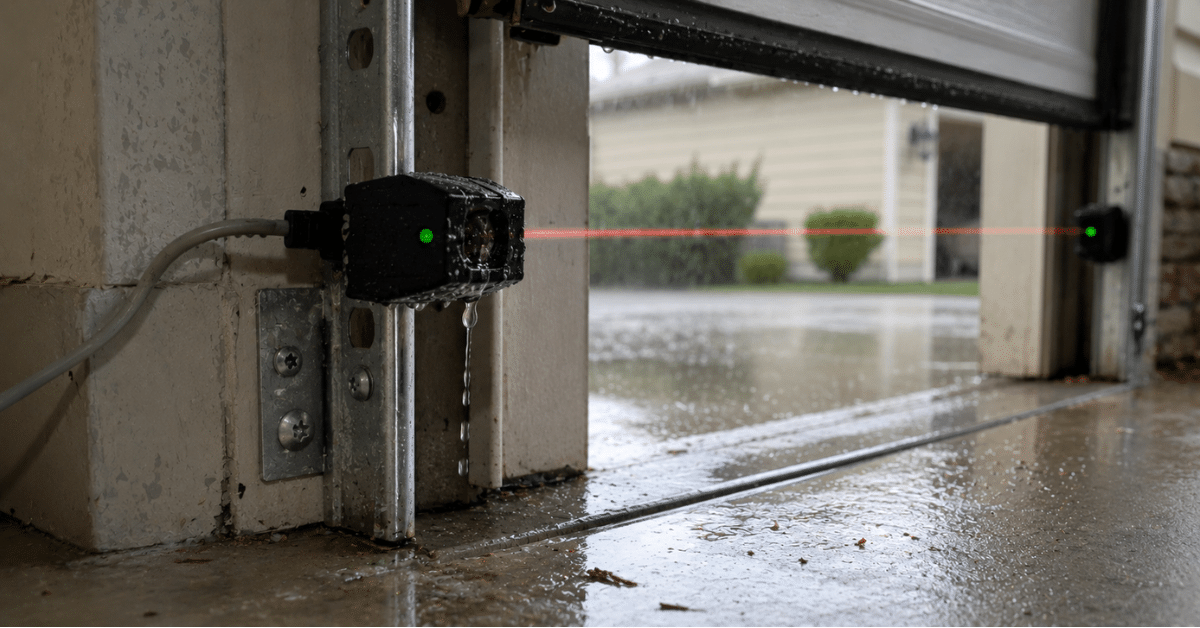
Water sitting directly on sensor lenses is the most immediate rain-related problem. Even a light spray of rain can coat the sensor face with droplets that scatter and diffuse the infrared beam enough to trigger a false obstruction reading.
Spotting a Lens Contamination Issue
Look at both sensors while it’s raining or right after. The sending sensor typically has a steady amber light. The receiving sensor should show a solid green light when the beam connection is clean. A blinking green light — or no light at all — signals the beam is broken or interrupted.
The Fix
Wipe both sensor lenses gently with a dry microfiber cloth. Check the lights again. If the green light returns to solid and the door closes normally, lens contamination was the entire problem. It takes thirty seconds and costs nothing.
Apply a small amount of Rain-X or a similar water-repelling treatment to the sensor lenses after cleaning. This helps water bead off instead of pooling on the lens surface during future rain events.
Sensor Misalignment Caused by Heavy Rain and Ground Shifting
Heavy rainfall saturates the ground around your garage foundation. That moisture causes subtle shifts in the concrete slab and door frame — small enough that you’d never notice visually, but large enough to knock a precisely aimed sensor out of alignment.
How to Check Alignment
Stand at the door threshold and look at both sensors. Each sensor sits in a bracket mounted to the bottom of the vertical track. The sending and receiving units must point directly at each other with no angular deviation. Even a few degrees of misalignment breaks the beam completely.
Check the indicator lights again. If the receiving sensor’s green light is blinking rather than solid, the beam isn’t landing cleanly on the receiver — misalignment is the likely cause.
Realigning the Sensors
Loosen the wing nut or mounting screw on the affected sensor bracket. Slowly rotate the sensor until the green light on the receiver turns solid. Tighten the bracket back down firmly. Test the door three times to confirm the alignment holds.
How Rain Affects Garage Door Sensors Through Electrical Interference
Water finding its way into sensor wiring is a less obvious but more serious problem. The low-voltage wires running from each sensor up to the opener unit run along the door tracks and through the garage wall. Gaps in wire insulation, loose terminal connections, and corroded wire ends all become active problems when moisture is present.
Signs of a Wiring Issue
The sensors show no lights at all — not blinking, not solid, completely dark. Or the lights behave erratically — solid one moment, off the next — without any physical obstruction near the sensors. These symptoms point to water reaching the electrical connections rather than just the sensor lenses.
What to Do
Inspect the full length of both sensor wires for cracked or damaged insulation. Check the wire terminals where they connect to the back of each sensor — look for green corrosion or loose connections. Dry the connections thoroughly and apply electrical contact cleaner. If the wiring is significantly corroded or damaged, sensor replacement is more reliable than patching.
Testing Your Garage Door Automatic Reverse
Condensation Inside the Sensor Housing
Texas weather — and the humidity that comes with it — creates a specific problem that rain alone doesn’t: condensation forming inside the sensor housing itself. When warm, humid air meets a cooler sensor surface, moisture condenses on the interior of the lens housing and scatters the beam from the inside out.
Why This Is Harder to Diagnose
You can wipe the outside of the lens clean and still get beam interference. The condensation sits behind the lens where a cloth can’t reach. The problem often clears on its own as the day warms up — which leads homeowners to assume the sensor is randomly malfunctioning rather than responding to moisture.
How to Address It
First, confirm the diagnosis by checking whether the problem appears consistently in the morning after humid nights and clears by midday. If the pattern matches, replace the sensor units — condensation that gets inside the housing repeatedly indicates degraded seals that won’t improve on their own.
New Braunfels Garage Door Repair serves New Braunfels, Seguin, San Marcos, Schertz, Cibolo, and surrounding communities. If your garage door sensors keep malfunctioning during or after rain, our technicians diagnose the exact cause and fix it the same day — no guesswork.
Garage Door Repair New Braunfels
How to Protect Garage Door Sensors From Rain Long-Term
Fixing the immediate problem is only half the job. Protecting your sensors from repeat rain damage saves you from going through this every storm season.
Practical Protection Steps
- Mount a small sensor shield or visor above each sensor using the existing bracket hardware. These plastic covers deflect direct rain spray without blocking the beam path.
- Check sensor wire insulation every six months and reseal any exposed sections with weatherproof electrical tape.
- Apply Rain-X to both sensor lenses at the start of each rainy season.
- Confirm sensor alignment after any significant storm — even storms that don’t appear to cause visible damage can shift the mounting brackets enough to affect beam accuracy.
A five-minute post-storm inspection catches small alignment and lens issues before they turn into a door that won’t close at all.
FAQ: How Rain Affects Garage Door Sensors
Q: Why does my garage door not close when it rains?
A: Rain causes water droplets to coat the sensor lenses, scatter the infrared beam, and trigger a false obstruction signal — making the door reverse or refuse to close entirely.
Q: How do I get my garage door sensors to work in the rain?
A: Wipe both sensor lenses dry with a microfiber cloth and check that the indicator lights return to solid. Applying Rain-X to the lenses helps prevent repeat issues during future rain.
Q: Can rain permanently damage garage door sensors?
A: Prolonged moisture exposure can corrode the sensor wiring and degrade the internal lens seals, eventually requiring sensor replacement rather than just cleaning or realignment.
Q: Why do my garage door sensors blink after rain?
A: A blinking green light on the receiving sensor means the infrared beam isn’t making a clean connection — usually caused by misalignment from ground shifting or water on the lens surface.
Q: How far off can garage door sensors be before they stop working?
A: Even a few degrees of angular misalignment is enough to break the beam entirely. The sensor brackets should always point directly at each other with no visible tilt in any direction.
Conclusion
Rain disrupts garage door sensors in four specific ways — lens contamination, misalignment from ground shifting, water in the wiring, and condensation inside the housing. Most of these have fast, simple fixes you can handle yourself. However, corroded wiring, failed sensor seals, and persistent misalignment after repeated storms point to components that need professional replacement rather than temporary patches.
Check your sensor lights every time your door misbehaves in wet weather. That blinking light tells you exactly where the problem is — and now you know exactly what to do about it.